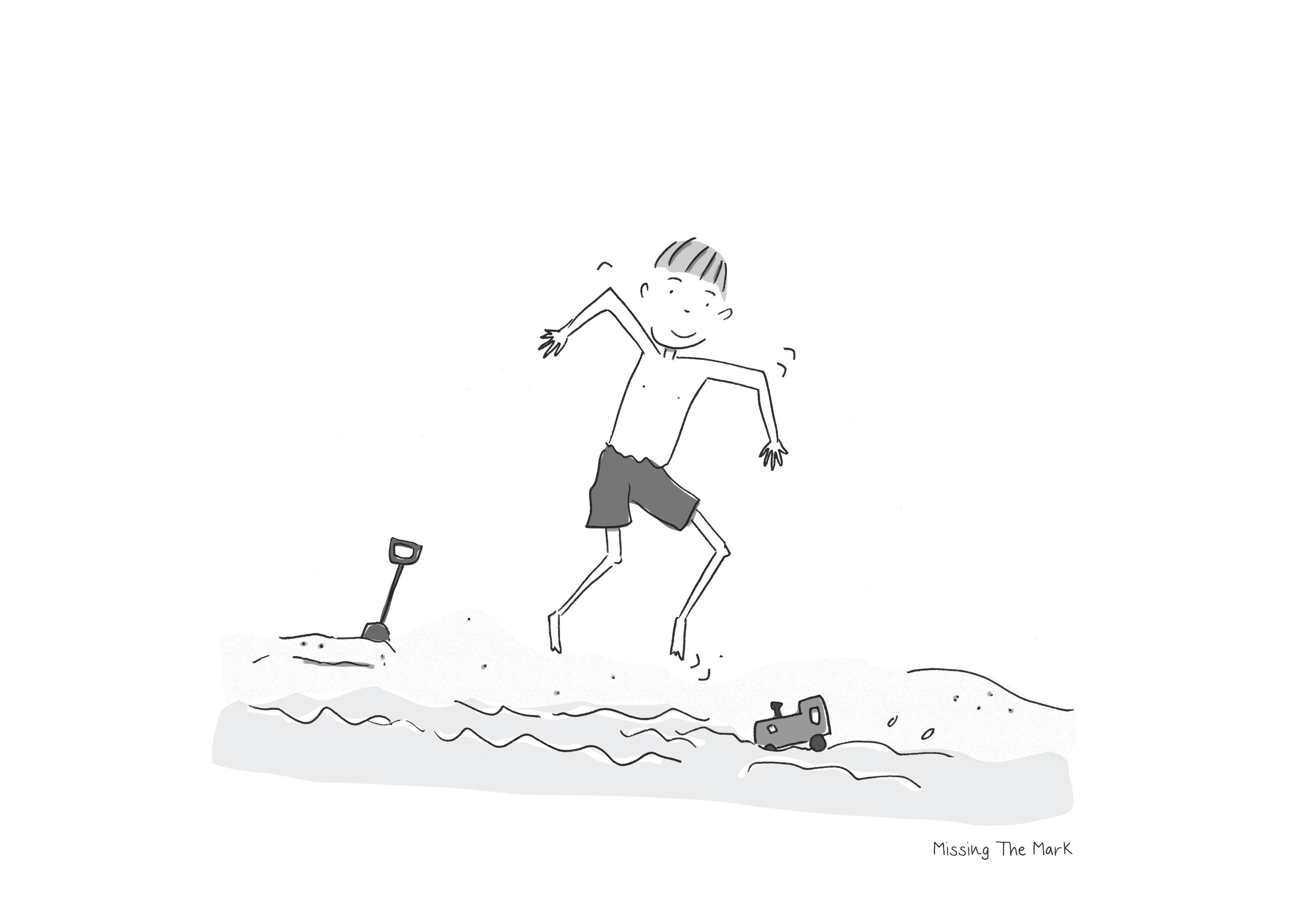
Bouncing boy...

I saw a boy on the beach last week.
He was about seven or eight.
His body was slim, wiry, bandy even, and it never stayed still.
His arms remained outstretched, bent at the elbows so they sat almost at right angles.
His legs danced constantly, toes pointed as he bounced from one foot to the other.
His arms lifted, dropped, lifted again.
He didn’t stop moving.
His time on the beach was wonderfully busy.
He danced between holes he dug in the sand and toy trains he washed in the sea, only to crash them dramatically back onto the shore so he could begin the washing ritual all over again.
Then a pause, a big think followed by a skip, a hop even.
Digging. Washing. Crashing. Beginning again.
The shoreline wasn’t just a place, it was his imagination made visible.
Every wave, every handful of sand, every new hole told him where the game would go next.
Whenever I walked close enough to see his face, his eyes were wide, thoughtful, completely absorbed.
Meanwhile, his mum chatted with friends a little way off, always within sight but relaxed enough to let him be.
He was free.
She was relaxed.
We found ourselves looking for him each day we returned to the beach. Seeing him somehow lifted our own day.
“He’s having the time of his life,” we kept saying.
And it made me think about classrooms.
About this same freedom. This imagination. This glorious busyness.
At what point does sitting still become a requirement rather than an option? When does movement become something to correct?
When does curiosity become something to contain?
Because what delighted us on that beach was precisely what we so often ask children to leave at the classroom door.
The dancing becomes fidgeting.
The prancing becomes distracting.
The imagination becomes off-task.
The freedom becomes something to tame.
There seems to come a moment when we decide these beautiful, dancing limbs should be folded away.
That this busy brain should become quiet.
But where does all that energy go?
Where do we put the child whose thinking lives through movement?
Why do we assume that stillness is the same as learning?
Perhaps the better question is not how do we make children stop moving?
Perhaps it is why must it stop?
Maybe we should see what happens when we let them keep moving.