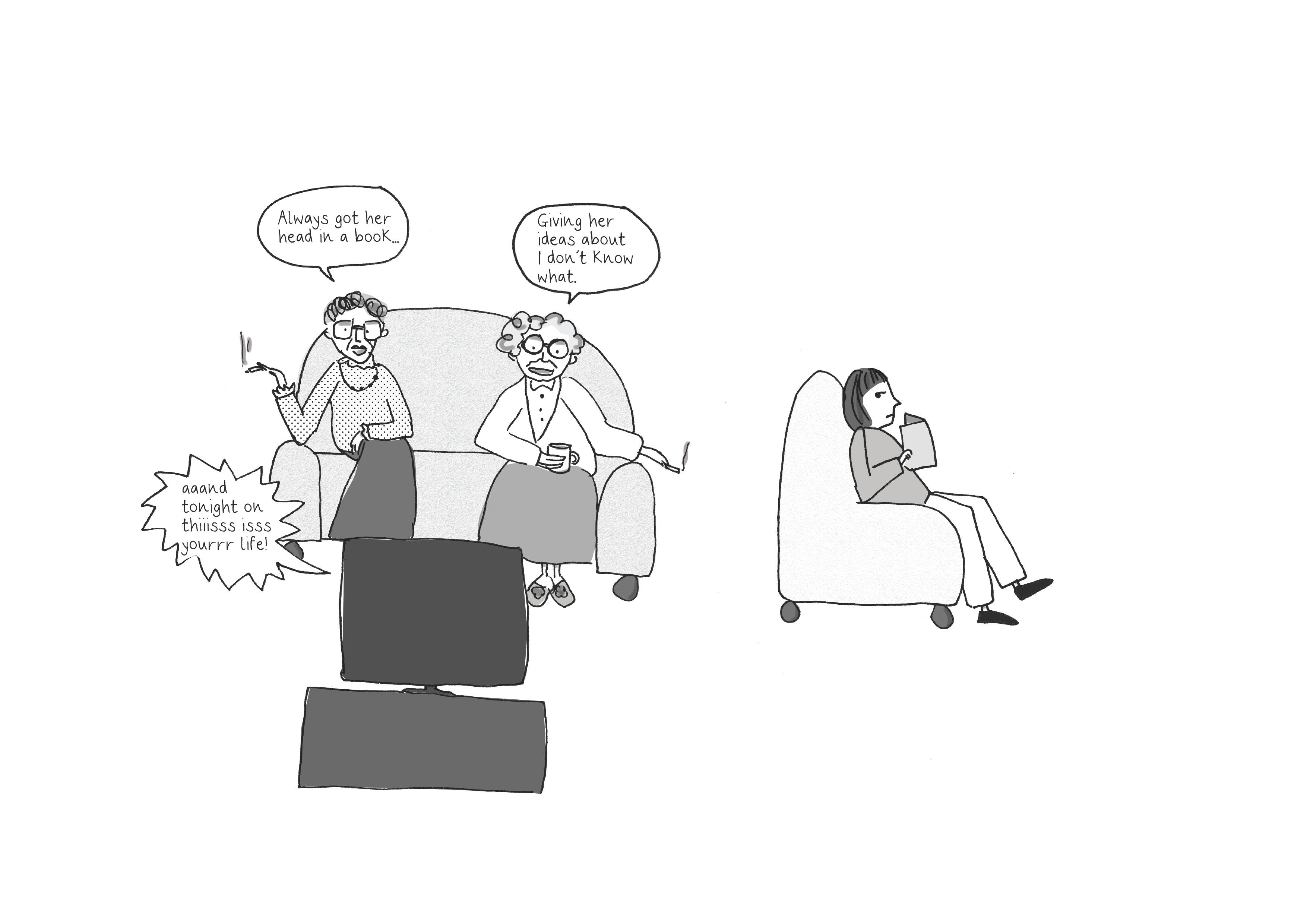
Books...

My mum grew up with her aunt and her mother in Chelsea, West London. There was nothing glamorous about it. They lived in a council flat with few modern comforts, so they were delighted to move into one of the new housing estates just off the King’s Road, complete with central heating and constant hot water. The location suited my nan too, as she cleaned the houses of wealthier families nearby.
My mum stayed with them until her late twenties, when she met my dad while they were both working at Hammersmith Library.
My mum has always been a voracious reader. As a child, if I couldn’t find her, it was almost certain she’d slipped away to “just finish this last chapter”.
I used to love to help her at the library, and one of my favourite jobs was cleaning returned books with methylated spirits before they went back on the shelves. Before choosing a pile to take home to read. Books shaped our home too, I remember the Virago books occupying their own special section, all books had their place. There was a special section just for the books still to read.
Once, after a gas leak that left my mum drifting in and out of consciousness, she told me that one of the thoughts keeping her fighting to wake up was that she still had so many books left to read.
My nan never understood that passion.
To her, books were almost antisocial. They stopped people talking. They filled your head with nonsense. She never asked what my mum was reading because, in her view, books simply got in the way of real life. Television made sense to her. Books did not.
Looking back, I don’t think her reaction was really about books at all. Reading had never been a source of confidence or pleasure for her. Beyond the occasional newspaper, it wasn’t part of her world.
The thing that gave my mum such joy and possibility made my nan feel excluded.
Books represented another world, one she couldn’t enter and feared might one day take her daughter away from her.
I begin with this story because it reminds us that every generation has had its “dangerous” new medium.
Books have been accused of spreading dangerous ideas.
Letter writing was said to create temptation for young women. Comic books were blamed for juvenile delinquency.
Films, rock and roll, Elvis Presley, television, computer games and now social media have all inspired waves of anxiety about what they might do to young people.
Some of those concerns have proved justified, many have not.
But the pattern is similar, we tend to greet new forms of culture and communication with fear before we understand them.
As we debate proposals such as a social media ban for young people in the UK, it is worth asking whether we are seeing something genuinely unprecedented or whether we are repeating a familiar cycle.
That doesn’t mean dismissing the real risks of social media.
Rather, it means approaching them with curiosity instead of panic, acknowledging both the harms and the benefits, and resisting the temptation to assume that newer automatically means worse.
We need to question how we have got here, why our children are on phones, what happens with all this data about them and what the ban means for parents and how can respond in a way that is thoughtful and realistic?
So I hope you can join me and educational psychologist Dr Chris Bagley for our webinar next Wednesday, July 8th at 7.30pm where we will discuss all of this and what our options are going forward.
So bring your questions and we hope to be able to answer them.